
AI Must Be Guided by Ethics, Not Replace Human Wisdom in Zakat and Waqf Transformation
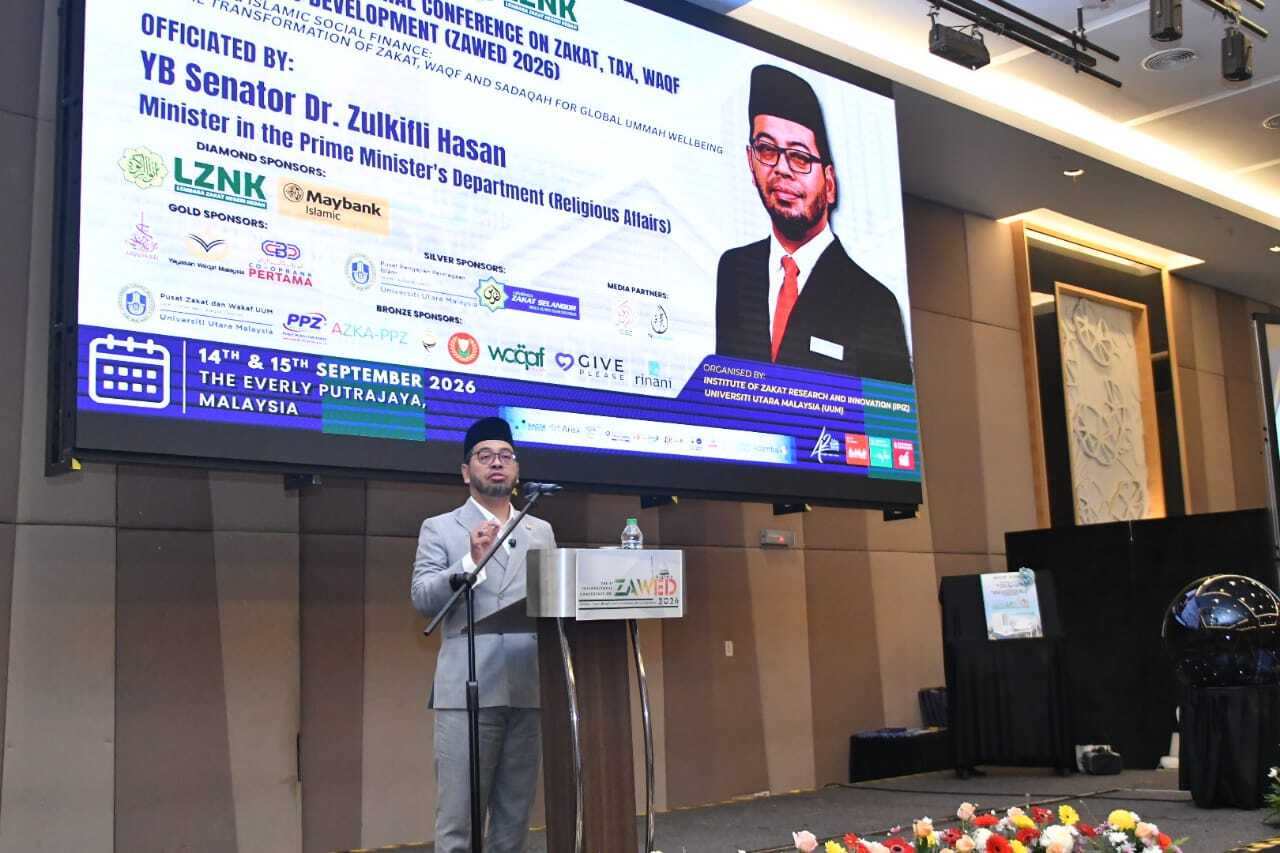 UUM ONLINE: Putrajaya – The use of artificial intelligence (AI) technology in the management of zakat (tithes) and waqf (endowments) must be guided by knowledge, ethics and good governance, with technology serving as a tool to empower people rather than replace human wisdom.
The Minister in the Prime Minister's Department (Religious Affairs), Senator Dr. Zulkifli Hasan, said the success of digital transformation in Islamic social finance should not be measured by the extent of technological capabilities available, but by how wisely they are harnessed to benefit society.
According to him, technology can help institutions identify human needs more accurately, determine appropriate forms of assistance, pinpoint those most in need and ensure the efficient distribution of resources.
“However, knowledge, ethics, collaboration and governance must form the foundation for determining what is fair, what is true and what genuinely benefits society.
“In an era where data increasingly shapes power, our greatest task is to ensure that technology remains a tool to empower humanity, rather than a substitute for human wisdom,” he said while addressing the 4th International Conference on Zakat, Tax, Waqf and Economic Development (ZAWED) 2026, organised by Universiti Utara Malaysia (UUM) in collaboration with the Kedah State Zakat Board (LZNK), here today.
Dr. Zulkifli stated that zakat and waqf management institutions must be developed not only with digital capabilities, but also with intellectual rigour, a steadfast commitment to ethical values and the ability to earn public trust.
He noted that data should be leveraged in the management of zakat and waqf to identify needs more accurately, prevent leakage, integrate assistance across institutions and measure the extent to which interventions genuinely bring about change in the lives of recipients.
“The question before us is no longer merely whether we can digitise zakat and waqf, but whether we are capable of transforming the way they are managed in the digital era,” he said.
He added that while AI has the potential to enhance efficiency in specific tasks, such improvements do not necessarily translate into overall productivity gains at the broader economic level.
“The greater the power a system possesses, the greater our responsibility to ensure that the system is transparent, accountable and aligned with Shariah principles and the public interest,” he said.
In a related development, Dr. Zulkifli said Malaysia, which has long been recognised as a global leader in Islamic finance, must continue to strengthen its position through research, innovation, digital transformation and evidence-based policymaking.
According to him, conferences such as ZAWED provide a vital platform for scholars, policymakers, industry practitioners and leaders from various countries to exchange views, present research findings and explore innovative solutions to contemporary socioeconomic challenges.
“I would like to extend my heartiest congratulations to UUM for spearheading this initiative in collaboration with the Kedah State Zakat Board and other strategic partners.
“At the Prime Minister's Department level, we are also ready to collaborate in efforts to strengthen this agenda,” he said.
Dr. Zulkifli also noted that the presence of agencies such as Department of Waqf, Zakat and Hajj (JAWHAR) and Yayasan Waqaf Malaysia, together with the establishment of the Perbadanan Wakaf Nasional Berhad, could further intensify efforts to strengthen the waqf ecosystem in a more effective and systematic manner.
He also welcomed the presentation of various papers and proposals at ZAWED 2026, describing them as highly relevant to current needs, particularly in addressing socioeconomic issues and formulating an agenda to strengthen both the Islamic economy and the national economy.
Meanwhile, the Vice-Chancellor, Prof. Dr. Ahmad Martadha Mohamed expressed hope that the conference would serve as more than just a platform for gathering and sharing views; he hoped it would generate ideas, resolutions and proposals that could be translated into action and deliver greater benefits to society.
“I hope participants will not only share their respective experiences and expertise, but also take home the knowledge, ideas and best practices gained throughout this conference.
“I would also like to take this opportunity to express my appreciation to all parties and co-organisers who collaborated with UUM, particularly the Institute of Zakat Research and Innovation (IPIZ), for making this conference a reality,” he said.
He further expressed hope that the relationships established, particularly between UUM and organisations directly involved in zakat, waqf and economic development, would continue to be strengthened and consolidated in the future.
The conference also witnessed the exchange of a Memorandum of Understanding (MoU) between UUM, represented by the Deputy Vice-Chancellor (Research and Innovation) Prof. Dr. Ram Al Jaffri Saad, and Universiti Sultan Zainal Abidin (UniSZA), represented by its Deputy Vice-Chancellor (Research and Innovation), Prof. Ts. Dr. Shukor Abd Razak. The exchange was witnessed by Dr. Zulkifli.
Additionally, the event also saw the launch of the books titled “Zakat Era Digital” and “Zakat Dan Pemerkasaan Masyarakat”, as well as the LZNK-IPIZ Special Research Grant Infographic Book Set.